
Customer service training activities and Ideas
A working toolkit, not a reading list. Filter 21 ready-to-run activities by the skill you want to build, open any one for the setup, a worked example and debrief prompts, then download the whole pack. Grounded in adult learning science, not scripts.


The most effective customer service training activities include role-play scenarios with difficult customers, active listening drills, de-escalation tone exercises, team games that build empathy, and short daily warm-ups that keep skills sharp between sessions. Activities work because adult learning science is clear: practice, reflection, and accountability change behaviour in ways that lectures and slide decks never do. The toolkit below gives you 21 ready-to-run activities, filterable by skill, with setup, a worked example and debrief guidance for each, plus a download.
Why customer service training activities beat lectures
A slide deck can explain what empathy is. An activity makes someone feel what it is like to be on the receiving end of a conversation that lacks it. That gap is the whole argument for activity-based learning.
Adult learning science, the foundation of every program at Oculus Training, is built on a clear finding: adults learn by doing, not by passively receiving information. The three conditions that turn a training exercise into a lasting behaviour change are the same three Kevin James has grounded his work in across 25 years and 5 continents.
Practice
The skill is only built when people attempt it in a low-stakes setting. Role-play and live exercises give the reps before the real moment arrives.
Reflection
After the activity, people examine what happened and why. This is the step most training skips, and skipping it is why skills stay in the room.
Accountability
A follow-up rhythm, coaching check-ins and measurement keep the new behaviour alive once the session ends. Without it, skills fade inside two weeks.
70-20-10 model, widely cited active-learning research and the forgetting curve. The takeaway is simple: practice plus reflection beats a lecture every time, and spacing it out is what makes it last.
Roughly how much sticks two weeks later, by how the material was learned.
Widely cited learning pyramid (National Training Laboratories). Treat the exact figures as directional. The pattern is the point: the more active the method, the more sticks.
Generic activities produce generic results. The ones below are starting points. The exercises that move the needle in your organisation are the ones built around your customers, your scenarios, and the specific moments your team finds hardest. That customisation is what separates a session people remember from one they forget by Friday.
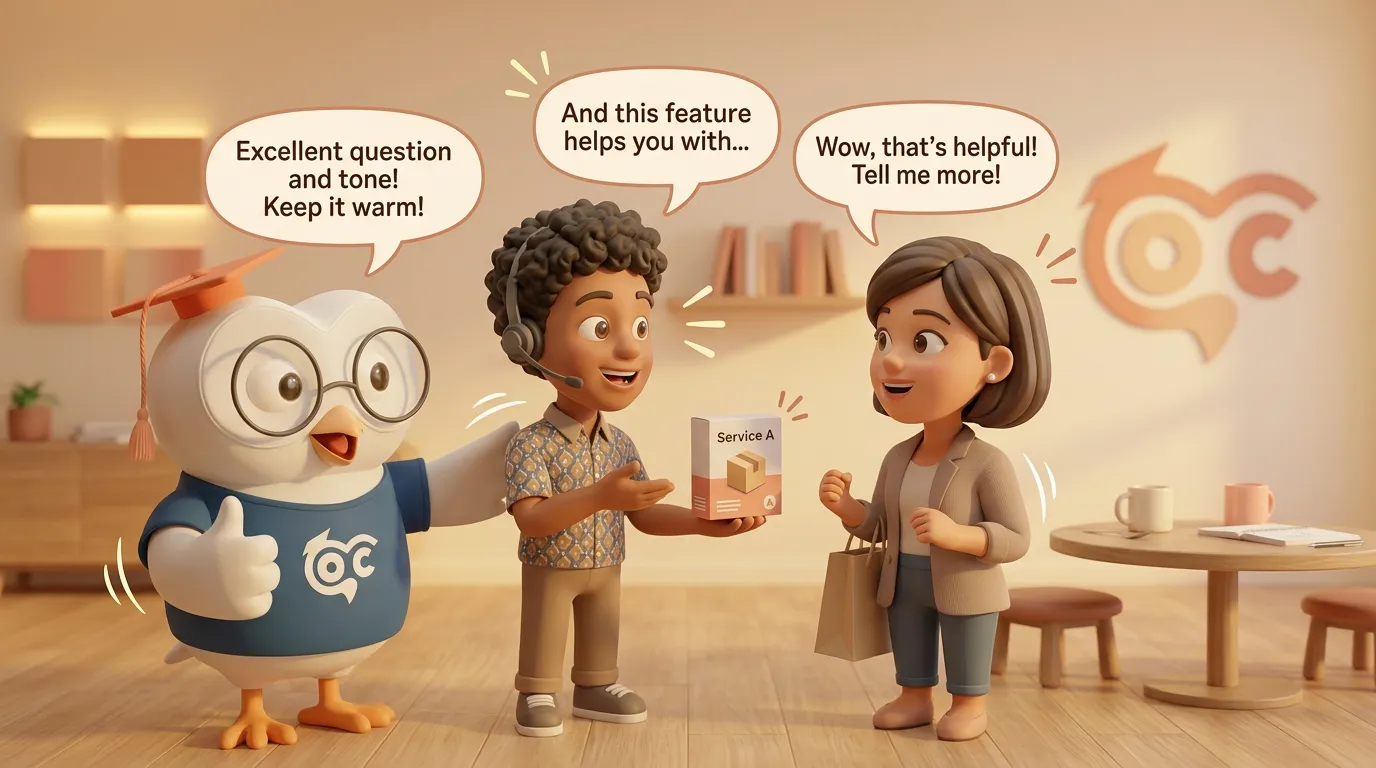
The customer service training activities toolkit
Twenty-one customer service training activities you can run this week. Filter by the skill you want to build, open any card for the setup, a worked example and debrief prompts, then download the whole pack to take into a session.
Short on time? Build your session.
Pick a goal and how long you have. We will draft a ready-to-run agenda from the toolkit below, timed and in order, with the debrief built in.
 Free resource · Activity pack
- Brief one person privately as the customer: they have had a genuinely bad experience and arrive frustrated, not hostile. Give them a specific grievance in writing beforehand, such as a delayed order, a wrong item, or an ignored complaint.
- The team member takes the interaction cold, for four minutes, without interruption. No coaching from the sidelines during the exercise.
- Observers note the single moment the conversation turns, either up or down. Ask them to track it silently, not aloud.
- Stop on time, even mid-sentence. Move straight into debrief. The pause before feedback lands is where the reflection begins.
"I have been waiting three days and nobody has called me back."
"Three days with no callback is not good enough, and I understand why you are frustrated. Let me sort this out now." Acknowledge before fixing. That order matters.
- Run the same scenario twice with the same person: once where they jump straight to fixing, once where they acknowledge first. The contrast makes the principle visible without a lecture.
- Swap the grievance card for a real complaint your team received this week. The authenticity raises the quality of practice immediately.
- Have observers hold up a card the moment they would have apologised, to surface how different people read the same interaction and when timing shifts the outcome.
- What did you notice about your own reaction in the first 30 seconds?
- At which moment did the conversation shift, and what caused it?
- Where will you meet a version of this customer in the next week?
- Write the original complaint on a card and give it to the team member to read before the exercise starts. They already know the background. The customer is arriving for the second time.
- The customer has already complained once and heard a hollow or deflecting response. This contact is their second attempt. They are not shouting; they are done giving benefit of the doubt.
- The team member must acknowledge the failure specifically, take clear ownership, and offer a genuine resolution within their authority. Vague sympathy does not count.
- Run it for five minutes, then debrief on ownership language: where it was concrete and where it was hedged.
"I'm sorry you feel that way. I will pass this on to my supervisor." No ownership, no action, no shift in the customer's experience.
"We let you down, that was our mistake, and here is exactly what I am going to do about it right now." Owning the failure by name is what shifts the customer's posture.
- Give the team member a printed list of 10 apology phrases and ask them to rank which feel genuine versus formulaic before the exercise. Their rankings often differ, and that difference is worth discussing.
- Run two rounds: one where the resolution offered is within the team member's authority, one where it is not. The second forces them to practise redirecting without abandoning ownership.
- Ask an observer to count the number of times the team member used the word "I" versus "we" versus "policy." The distribution reveals a lot about how ownership is framed.
- Did the apology land as genuine, and what specifically made it feel that way or not?
- At which moment, if any, did the team member avoid ownership, and how did the customer respond to that?
- What is the difference between apologising for how someone feels and apologising for what happened?
- Run this over actual phones or speakerphone, not face to face. The constraint is the point: participants cannot lean on body language, eye contact, or facial expression. They have only voice.
- The caller is escalated from the opening line. Brief them to stay at a high emotional pitch for at least the first 90 seconds, regardless of what the team member says. The team member must slow the pace, lower the emotional temperature, and move toward resolution without matching the caller's energy.
- Run three rounds with different people so the group can compare approaches. After each round, observers note one thing the team member did that lowered the temperature.
- On the final round, ask the team member to deliberately mirror the caller's pace and energy for 20 seconds, then shift. The contrast makes the technique tangible.
"I have been on hold for 40 minutes and I want to speak to a manager RIGHT NOW."
"I want to get this fixed for you. Give me one minute to pull up your account." Drop your pace and pitch. Calm is contagious. So is panic.
- Record a round on a phone and play it back. People hear their own pace and pitch very differently from how it felt in the moment. The playback is often the most useful feedback of the session.
- Add a hold transfer in the middle of the call. The customer has already been transferred once. The team member must re-acknowledge the situation without making them repeat themselves from scratch.
- Run it with the team member standing versus sitting. Posture affects vocal quality and energy in ways people do not expect until they feel it.
- What did slowing your pace do to the caller's energy, and at what point did you notice a shift?
- Which words or phrases made things worse before they made them better?
- What does it feel like physically to stay regulated when someone is escalating at you?
- Choose a policy, product, or process that your team explains regularly and that customers commonly misunderstand. Brief the customer to ask follow-up questions whenever something is unclear, not to play difficult, but to play genuinely confused.
- Run the explanation once at normal pace with the team member's default language. Let it run to completion without interruption. Ask the customer to rate their understanding out of 10 at the end.
- Now run it again with the same person. This time, no jargon, no industry terms, and no assumptions about what the customer already knows. The customer rates their understanding again.
- Compare the two scores and unpack what changed. The contrast between rounds is the learning, not a critique of the first attempt.
"Your claim is currently in adjudication with our third-party administrator pending secondary review."
"Your claim is with the team who approves it. That usually takes about three days, and I will send you a message the moment it moves." Same fact, zero jargon, one clear next step.
- Ask the team member to write down the five industry terms they use most often, then challenge the group to produce a plain-language replacement for each. Post the list somewhere visible in the team space.
- Run the exercise with a real team member explaining something to a colleague from a completely different department who has no context. Their genuine confusion is more useful than a simulated one.
- After the explanation, ask the customer to explain it back as if they were telling a friend. What they produce reveals exactly what landed and what did not.
- How did you know the customer understood? What specific signals were you reading?
- Which words felt normal to you but were confusing to them, and why does that gap exist?
- What checking-for-understanding moves did you use, and which ones worked best?
- Choose a real scenario where a firm limit applies: a refund outside the window, a discount that does not exist, an exception to a policy that cannot be bent. Write it on a card for the team member. The goal is not a workaround. It is to decline clearly, warmly, and with at least one real alternative.
- The customer pushes back after the first no. Then pushes back a second time. The team member must hold the position without becoming cold, dismissive, or apologetic to the point of implying the policy might change.
- Observers track specifically whether the alternative offered was genuine or a placeholder. A real alternative changes something for the customer. A placeholder just fills the silence.
- Rotate pairs and compare how different team members frame the same refusal. The variation is illuminating.
"I'm sorry, I really can't do anything about this. It's just the policy." Final, unhelpful, and leaves the customer with nothing.
"I can't refund this outside the 30-day window. What I can do is send a replacement part today at no charge." A clear no, plus a real alternative that actually helps.
- Before the exercise, have the team brainstorm every real alternative that exists within their authority for the most common refusal scenarios. Writing them down in advance means the alternatives are available in the moment rather than improvised under pressure.
- Run a version where the team member is not allowed to use the word "policy" at any point in the interaction. They must find other language to explain the limit.
- Have observers rate the no on two dimensions separately: how clear it was, and how warm it felt. Both matter, and they are often in tension.
- Did the no feel final without feeling hostile? What specific words created that effect?
- Were the alternatives offered genuine, and how did the customer's body language or tone respond to them?
- What is the difference between holding a position confidently and being dismissive?
- Person A describes a work problem or customer scenario for two full minutes. No interruptions, no questions, no notes. Person B listens only.
- After two minutes, Person B paraphrases back. Not a summary of events. An attempt to reflect both the content and the feeling underneath it. The distinction is critical.
- Person A rates accuracy separately on two dimensions: did Person B get the facts right, and did they get the emotional content right? These scores are almost always different, and the gap between them is the lesson.
- Rotate pairs and compare ratings across the group. Where does emotional content consistently get dropped?
"So you want a refund." Accurate on the surface request, but misses the frustration, the sense of being ignored, and the emotional weight behind the ask.
"It sounds like the bigger issue is that you felt ignored, and the money is almost secondary to that." Names the feeling, not just the transaction. That is what makes someone feel heard.
- Run the exercise but prohibit Person B from using any of the same words Person A used. This forces genuine interpretation rather than echo-paraphrasing.
- Add a third dimension to the rating: did Person B rush to a solution before completing the paraphrase? Many people cannot resist it, and seeing the pattern is useful.
- Use an actual customer complaint email as the source material, so the content is grounded in something real the team will recognise.
- What did it feel like to be listened to for two full minutes without interruption?
- Where did the paraphrase get the facts right but miss the emotional content, and why does that gap matter?
- When do you find it hardest to resist solving before you have fully listened?
- Each participant writes down the last time they were genuinely frustrated as a customer: a shop, a call centre, a website, a service desk. What happened, how it felt, what they needed and did not get. Two to three sentences is enough.
- In pairs, they swap accounts and read each other's. Each person answers one question in writing: what single thing would have changed the outcome for this customer?
- Pairs share their "one thing" with the full group. Capture them on a whiteboard or shared screen. Common themes will surface quickly.
- Ask the group to map how many of those themes exist in their own team's interactions right now. That mapping is where the exercise becomes operational.
"I was on hold for 40 minutes, got transferred twice, and then the call dropped. Nobody called me back."
"A callback option at the start of the hold. That one change removes the frustration of waiting and the devastation of the dropped call." Often the fix is genuinely small.
- Ask participants to choose a frustrating customer experience from a completely different industry to their own. Cross-industry comparisons often surface fixes that are obvious elsewhere but invisible when you are too close to your own processes.
- After the group discussion, ask each person to name one friction point they can personally remove or reduce in the next week. Specificity is what makes the insight actionable.
- Run the exercise with new starters alongside experienced team members. New starters often have more recent and vivid customer memories, and their accounts shift perspective for the whole group.
- What themes appeared across the group, and how many of them apply to your own customers right now?
- How often was the fix something small and within a front-line team member's control?
- What does it feel like to read someone else's frustration rather than just hear about it?
- Prepare five short customer statements, each carrying a different underlying emotion. Frustration, embarrassment, anxiety, disappointment, and quiet anger each read differently and require a different acknowledgment. Read them one at a time.
- After each statement, participants write down silently: the emotion they detect, and the one sentence they would say to acknowledge it before doing anything else. Individual writing before group discussion is important. It prevents the loudest voice from setting the answer.
- Share and compare. There are no wrong answers, but some are more precise than others. The variation in the group's responses is itself a teaching moment about how differently people read the same signal.
- Discuss what changes when you acknowledge before you solve, and what happens in a customer interaction when you skip it.
"I guess I'll just figure it out myself." Flat delivery, slightly resigned. The emotion is disappointment, not anger.
"I don't want to leave you to figure this out alone. Let me stay with you on this." Names the feeling in the customer's words without diagnosing them, and signals commitment.
- Use voice recordings of the statements rather than reading them aloud. Tone of voice carries the emotional signal more accurately than text, and the exercise becomes more realistic.
- Add a sixth statement that is deliberately ambiguous. Discussing why it is hard to label is as useful as labelling the clear ones correctly.
- After the exercise, ask each person to identify the emotion they find hardest to name in a customer interaction and why. That self-awareness is the foundation of the skill.
- Why does naming the emotion before solving matter, and what happens to the customer's experience when you skip it?
- Which emotional states were hardest to label accurately, and what does that tell you about where your team's blind spots might be?
- What is the difference between acknowledging an emotion and agreeing with someone's complaint?
- Hand each participant a sheet with ten phrases that commonly escalate a conversation. "That is our policy," "I cannot do that," "You should have read the terms," "That is not my department," and similar. These should be phrases your team actually uses, not invented ones.
- Working individually, each person rewrites every phrase to carry the same information without triggering defensiveness. Three to five minutes, no discussion yet.
- In small groups, compare rewrites. There will be several good versions of each. The goal is not to find the single right answer but to build a repertoire the team can draw on.
- Share the strongest rewrites with the full group and capture the ones that feel natural to say. Naturalness matters: a technically better phrase that no one will actually use in the moment is not an improvement.
"That's our policy." Shuts the conversation down. Signals the wall before the customer has finished thinking.
"Here is how this normally works, and here is what I can do for you." The information survives. The wall comes down. The conversation stays open.
- Ask participants to add their own phrases to the list before starting. The phrases people nominate are often the ones they hear from colleagues and already know are a problem. That ownership sharpens the learning.
- Run the exercise in reverse: give participants the improved versions and ask them to identify what the original probably was. The reverse direction is harder and reveals a different kind of awareness.
- After the session, post the team's top five rewrites somewhere visible, such as a shared channel or a card by the phone. The repeat exposure reinforces the new habit.
- What specifically made the original phrases feel dismissive or defensive?
- Which of these phrases do you hear on your own team regularly, and what does the customer do when they hear them?
- Which rewrite felt most natural to say, and why does that matter?
- Give the whole group the same neutral sentence: "I understand. Let me see what I can do." One sentence, no additional context. Everyone reads it in their head first.
- Ask three volunteers to deliver the sentence three ways: warmly and fully engaged, flatly and disengaged, and with barely concealed irritation. Brief each person privately so the group has not heard the instruction and cannot guess which version is coming.
- After each delivery, the group votes on which version they experienced. Then unpack what created the effect: speed, pitch, pausing, eye contact, pace of movement.
- Invite volunteers to try a version they have heard from a colleague recently, not as a caricature but as an honest impression. That often produces the most useful discussion.
"Let me see what I can do" delivered with a pause before and a slight drop in pace lands as a genuine offer. Delivered quickly with a rising inflection, it reads as a brush-off. Nothing changed except delivery.
Record one round on a phone and play it back. The team hears the difference instantly, and the person who delivered it almost always reacts with surprise at how it sounded versus how it felt from the inside.
- Run the exercise with a sentence the team agreed was "fine" in a recent customer interaction, then deliver it in all three tones. Often the team realises the delivery, not the wording, was the problem.
- Ask participants to think of a phrase they hear regularly on the team that sounds worse than it probably intends to. Bring it into the exercise as the test sentence for the next round.
- Extend into written tone: send the same sentence as a chat message with different punctuation and capitalisation. "Let me see what I can do" versus "Let me see what I can do!" versus "Let me see what I can do." Each reads differently to a customer.
- What changed the meaning across the three versions: speed, pitch, pausing, something else?
- How do you think your default tone reads to customers, and what would a customer say if you asked them?
- Is there a version of this sentence you recognise from your own habits, and what would you change about it?
- Write four versions of the same scenario, each one rung higher on the emotional ladder: mildly dissatisfied, clearly frustrated, openly angry, and emotionally distressed. The situation is identical. Only the intensity changes.
- Run all four versions in sequence with the same team member. Do not pause for feedback between rounds. Let the person experience the shift in intensity continuously. This mirrors what can happen in a real interaction that escalates.
- The goal is to demonstrate that the same core technique, acknowledge, stay regulated, focus on the very next step, holds at every level. The only thing that adjusts is pacing and the amount of acknowledgment before moving to resolution.
- After all four rounds, the full group discusses where the technique held, where it strained, and what the team member did at each transition point.
"I understand, and I am going to help." Delivered to a mildly annoyed customer, it lands lightly. Delivered to someone in open distress, it lands as a steadying presence. The technique holds. Only the pacing changes.
The customer begins to cry. The team member slows further, removes the transactional language entirely, and stays in the moment: "Take your time. I am not going anywhere." Fixing comes later. Being present comes first.
- Run the four levels with four different team members so the group can compare how different people handle the same intensity. The variation reveals different strengths and different points of strain.
- Add a fifth scenario where the customer crosses from distress into abusive behaviour. This gives the team member the chance to practise setting a boundary clearly and calmly before using a script for escalation or transfer.
- After the exercise, ask participants to identify which of the four levels they find most difficult and why. Self-knowledge about where composure breaks down is the first step in managing it.
- At which level was it hardest to stay regulated, and what physical signals told you your stress response was activating?
- What adjusted between levels, and what stayed exactly the same?
- What techniques were most useful at the highest level of intensity?
- In groups of four or five, each person shares a brief story of genuinely poor service they experienced as a customer. Two minutes each, uninterrupted. The stories should be real: a specific situation, not a composite.
- After everyone has shared, the group votes on which story describes the failure that would have been easiest to prevent, and discusses why that prevention was so achievable but did not happen.
- Each group nominates a spokesperson and shares their chosen story and the "easiest prevention" insight with the full team.
- Facilitate a full-group discussion to identify recurring patterns. Are the failures mostly about knowledge, attitude, process, or communication? Map them visibly so the team can see the distribution.
"I was passed between five different people, and each one said it was someone else's problem. Nobody owned it."
That story becomes the team's shorthand: "Let's not do a five-department." When the group names the failure together, the label sticks and the behaviour it describes becomes easier to catch and call out.
- After the session, ask the team to spend one week noticing moments in their own interactions where they are at risk of becoming someone else's "worst service" story. Report back at the next team meeting.
- Run the exercise in reverse: "the best service I ever received." The contrast between the two sessions reveals exactly what separates them and makes the standards concrete rather than abstract.
- If the team is new or shy, start with stories from outside the industry. The psychological distance makes it easier to be candid before turning the lens inward.
- Were the failures mostly about knowledge, attitude, process, or communication? Which category does your team fall into most often?
- How many of the failures described today exist in your own team's current interactions?
- What would change on this team if everyone had heard these stories and taken them seriously?
- Write a detailed customer complaint: a specific name, dates, products, and, crucially, the emotional weight of the situation. Include both the factual problem and how it made the customer feel. Read it aloud once, clearly, to one person only.
- That person retells it in their own words to the next person, who retells it to the next. No reading, no notes. Run it through four or five people in sequence.
- The final person reads their version aloud to the full group. Then read the original aloud immediately after. The room will hear the gap.
- Identify exactly what changed. Pay close attention to whether facts or emotional content dropped first. The answer is almost always emotional content, and that is the most important insight.
"She was devastated. Her anniversary gift arrived broken, a week late, and nobody from the company had contacted her despite three emails."
"Something about a late order, I think someone emailed." The emotion drops out first, every time. That is the lesson, and it lands harder when people hear it happen in real time.
- Run a second round where participants are allowed to write one keyword as a memory aid before passing the complaint on. Compare the accuracy between rounds. The difference is usually striking and opens a conversation about note-taking habits.
- Use a real anonymised complaint from your own operation as the source material. The authenticity raises the stakes and makes the distortions feel more consequential.
- After the exercise, ask the group: if this complaint had travelled through your team before reaching a resolution, what would the resolving team member have known? What would they have missed?
- What information was dropped, and what was exaggerated or altered?
- Why does the emotional content tend to disappear before the factual content?
- What does this tell you about how complaints travel through your team before reaching the person who resolves them?
- Give each small group a blank interaction: a common scenario specific to your business. A returns call, a billing dispute, a first contact from a new customer. Make it specific, not generic.
- Each group maps the ideal version from first contact to resolution. They must include the specific words and phrases at each step, the tone, and the concrete actions. Bullet points are fine. The work is in the specificity.
- Groups present their maps to the full team. As each group presents, the others note where their own map overlaps and where it diverges.
- Together, identify what is common across all versions. That shared ground becomes the team's emerging standard, written in their own language, not imposed from outside.
Three groups independently map a returns call. All three open with an apology and one clarifying question before touching the system. That overlap is an emerging standard, generated by the team itself rather than handed down.
One group includes a follow-up message after the call. The others do not. That divergence becomes a discussion: is the follow-up actually valuable, and if so, why is it not consistent?
- After the session, ask one volunteer to run the ideal interaction live with a simulated customer, using only the map the group created. Seeing it performed tests whether the standard is realistic or aspirational.
- Run the exercise twice with the same scenario: once for "what we currently do" and once for "what we want to do." The gap between the two is the training priority list.
- At the end, ask each person to identify one step in the ideal map that they personally do not do consistently. That self-identification is more powerful than a manager pointing it out.
- Where did the groups agree without discussion, and what does that tell you about your team's genuine shared values?
- Where did they diverge, and is the disagreement about preference or about a genuine gap in shared understanding?
- How close is this ideal map to what actually happens on the floor today?
- Present a customer scenario with zero demographic information. No name, no age, no background. Just the situation: "The customer struggled to follow the instructions and called in for help." Ask participants to write down, silently and individually, what they picture. Do not share yet.
- After 30 seconds, reveal a version of the customer with a background, age, or communication style that differs from what most of the group imagined. Do not frame the reveal as a catch or a gotcha. Frame it as useful information about how the mind fills in gaps.
- Discuss how the imagined customer might have affected the approach: tone, pace, assumptions about technical knowledge, patience. Then discuss what a genuinely consistent response would look like regardless of who the customer turns out to be.
- This exercise draws on the same behavioural science Kevin James uses in sensitivity and respectful-workplace programs. Keep the discussion grounded in behaviour and impact, not in labels or categories.
"The customer struggled to follow the written instructions and called in for help three times in one day."
Most participants picture an older caller. The customer is a rushed 28-year-old engineer reading the instructions on a phone screen between meetings. Assumptions shape tone before a word is spoken, and often before the phone is even picked up.
- Run a second round where participants write down the assumptions they might make about an impatient customer, a non-native speaker, or a customer who uses formal language. Then flip each. The pattern of assumptions is more useful than any single example.
- Ask: if you could not know anything about a customer before the interaction began, what would your default approach be? Use that answer as the benchmark for inclusive service.
- Connect explicitly to real scenarios from your operation where assumptions have led to a service failure or a complaint. The bridge from theory to practice is what makes this exercise operationally useful rather than merely interesting.
- What assumptions did the group make, and where do you think they came from?
- How might those assumptions affect real interactions before a word is exchanged?
- What would it take to catch an assumption before it shapes your response?
- At the start of the shift, the manager or team lead reads one real customer scenario from the previous week, anonymised. One to two sentences. The situation, not the resolution.
- Give the team 90 seconds to discuss how it should have been handled. No formal roles, no raised hands, just a quick open conversation. The informality is deliberate: this is a thinking habit, not a training event.
- The manager offers the actual outcome in one sentence, or confirms the team's answer if they got it right. Either way, the discussion has value regardless of whether the answer was correct.
- Five minutes total, including the scenario reading. Keep it tight. If it runs longer, it becomes an event rather than a habit, and habits are what you are building.
"A customer wants a full refund on an item that is clearly used and outside the return window. They say it was a gift and they did not know about the policy."
The team aligns on: acknowledge the situation, confirm the limit clearly, offer one genuine alternative such as a store credit or an exchange. One discussion, a shared answer, back to work.
- Keep a running log of the scenarios used each week. Over a month you will have a bank of real situations your team has already discussed. That bank is more useful than any generic scenario library.
- Once a week, instead of reading a problem scenario, read a positive one: a customer interaction that went exceptionally well. Ask what made it work. Reinforcing good behaviour is as important as correcting gaps.
- Rotate who reads the scenario so it is not always the manager's voice. Team members who run it often bring more candid discussion because the dynamic shifts slightly.
- Was there consensus in the team's response, or did it split? What drove the different answers?
- Does the disagreement reveal a gap in your team's shared standards, and how should that gap be addressed?
- If this scenario came in today, is everyone now aligned on how to handle it?
- Before the shift, choose one phrase the team actually uses regularly. Not a phrase from a training manual. A phrase you heard on the floor this week or a phrase the team would recognise immediately as their own.
- Write it on a whiteboard or post it to the team channel. Ask each person to suggest one replacement that feels more human, clearer, or less defensive. Responses can be verbal in a huddle or written if the team is remote or spread across a shift.
- Choose two or three options together as a group and vote or agree on the team's favourite. That phrase becomes the day's default. Name it: "today we are using..." The naming makes it a conscious commitment.
- At the end of the shift or the next day, spend 60 seconds asking who used it, what the customer's response was, and whether it felt natural. That feedback closes the loop.
"No problem." Neutral on the surface, but signals that the customer's request was potentially a problem you have generously overlooked. Small but cumulative.
"Happy to help." Shifts the frame entirely: helping is the job and the team is glad to do it. Small, daily, cumulative. That is how language habits change.
- Keep a shared list of phrases that have been through the rewrite process. Over time this becomes the team's own language guide, built from their own work, not copied from a policy document.
- Once a fortnight, revisit a phrase from two weeks ago and ask whether the replacement has become natural. If it has not, discuss why and try a different version. Behaviour change is iterative.
- Invite team members to nominate the next phrase rather than the manager always choosing it. Their nominations reveal what they are actually noticing in their own language and in each other's, which is exactly the awareness you are building.
- Why did the original phrase feel less effective than it could be?
- What did the rewrite add, and is there a version everyone feels comfortable using consistently?
- Did anyone use the new phrase today, and what did it feel like to say it?
- Two team members, one scenario card, 60 seconds on a clock. The customer presents a situation and the team member responds. The scenario is drawn from a real card deck, a stack of common situations your team faces. One new card per day keeps it from becoming predictable.
- No feedback, no coaching, no interruption during the 60 seconds. The observer watches only. The brevity is deliberate: it makes practice feel like a routine part of the shift rather than an event to brace for.
- After the 60 seconds, the observer gives one observation. Not a score, not a list of improvements. One thing that worked. Positive reinforcement of specific behaviours consolidates them faster than critique.
- Rotate pairs across the week so different combinations of people practise together. The variety prevents habits from calcifying around one partner's expectations.
"Customer cannot find their order number and is getting frustrated trying to navigate the website."
"You stayed warm the whole time and you did not rush them." That is enough. Reps without the pressure of a full exercise, and the specific positive observation tells the team member exactly what to keep doing.
- Build a physical card deck over time from real scenarios your team encounters. When team members contribute cards, they are also practising noticing what is difficult, which is itself a skill.
- Once a week, run the 60-second exercise with the scenario delivered in writing on a screen rather than spoken aloud. This builds the same response speed for chat and email interactions.
- After a month, run a team vote on which scenario cards were hardest. The ones that come up most often are your next training priority.
- What felt natural, and what felt forced or improvised in a way that surprised you?
- Where did the instinct to reach for a script or a policy kick in, and what would have happened if you had stayed with the person instead?
- Is there a scenario you keep hoping does not come up? That one is worth practising next.
- Pick two or three competitors, plus one company you genuinely admire from any industry.
- Each person calls as a real customer with a real question, and notes the wait, the tone, the language and how the request was handled.
- Regroup. Each person shares one thing worth stealing and one thing to avoid.
- Turn the best of what you heard into a phrase or habit your team adopts this week.
How long until a human answered, did they use your name, did they sound genuinely willing to help, and how did they handle not knowing something?
One phrase worth copying, and one moment that made you feel like a number. Specific beats general every time.
- Call your own line anonymously and score it the same way. The gap between how you sound and how you think you sound is usually the lesson.
- Compare a budget brand and a premium brand in the same sector. What does the premium one actually do differently in the first 20 seconds?
- Where it is legal and disclosed, record the calls so the team can listen back together.
- What did the best call do that we do not?
- What did the worst call do that we sometimes do too?
- What is the one thing we will copy this week?
- Play a recording of a real mystery shop of your own team. An Oculus mystery shop gives you the recordings to use.
- Before any discussion, each person privately scores it against your service standard.
- Play it again and stop at the turning points. What was said, and what was felt?
- Agree one specific change the team will make based on what you heard.
A request can be technically resolved while the customer is left feeling dismissed. Note the moments where the tone and the outcome disagree.
Have everyone rate the same call out of ten before anyone speaks. The spread in scores is itself a conversation about what your standard really is.
- Play a strong shop and a weak one back to back. The contrast teaches faster than either one alone.
- Mask the details and let the team guess which branch or shift it was. Assumptions surface quickly.
- Pair it with the role-play cards: re-run the same scenario live, right after hearing the real one.
- Where did intention and impact come apart?
- What would a ten out of ten have sounded like here?
- What is the one change we are committing to?
- One person scores their own recorded interaction or mystery shop against the standard.
- A colleague scores the exact same interaction independently, without seeing the first score.
- Compare the two side by side, and talk only about where they differ.
- Agree what the standard actually means for the moments you disagreed on.
We almost always rate ourselves on intention, and others rate us on impact. A two-point gap is normal and useful, not a failure.
Score observable moves: did they acknowledge the emotion, did they confirm the fix? Not a vague sense of how it felt.
- Rotate evaluators so everyone both gives and receives feedback over time.
- Score against what the customer effectively decides: would they come back, would they recommend you?
- Bring in a neutral evaluator, a manager or an Oculus assessor, for the interactions that matter most.
- Where were you hardest on yourself, and where too easy?
- What did your colleague catch that you missed?
- What does our standard actually require in that moment?
How to debrief well
The activity is the spark. The debrief is where the learning lands. Most facilitated sessions spend most of the time on the exercise and a few minutes on the debrief, then wonder why nothing changes on the floor. Kevin James's approach, grounded in his Master's in Organizational Change from York St. John University and 25 years of behaviour-change work, reverses that proportion for complex skills.
A good debrief does four things.
Name what happened, not what should have
The first question is always observational: what did you notice? Judgment before observation shuts down honest reflection.
Separate the skill from the person
The behaviour was clumsy or effective, not the person. People improve faster when feedback is attached to actions, not identity.
Connect it to a real situation
Ask where they will meet this in the next week. That bridges the training room to the floor, the transfer problem most programs fail to solve.
End with one specific commitment
Each participant names one thing they will do differently tomorrow. One. Specific and observable. That is the accountability that keeps the learning alive.
If you are running these without a dedicated facilitator, the debrief prompts on each card are designed to be run by a manager or team lead. You do not need training expertise to ask good questions. You need to ask them consistently.
Before you run any activity
Tick these off before you start. They are the difference between an exercise people enjoy and one that actually changes how the team handles customers. We can run any of these with you.

How to make the learning stick
Activities inside a training session build the skill. What happens in the two weeks after the session determines whether that skill survives. This is the piece most organisations skip, and it is the reason one-session training programs rarely produce durable change.
A single session builds the skill. Whether it survives depends on the two weeks after. That gap is exactly what reinforcement closes.
Three things make the learning stick once the session ends.
Spaced repetition
Two sessions two weeks apart beat a full-day immersive. The brain gets time to encode and the person gets to try it at work in between. The warm-up activities are built for exactly this.
Manager reinforcement
If the manager never references the training, the team assumes it does not matter. A short acknowledgment in a meeting, a technique named in coaching, a question in a check-in: these signal it is permanent. That is why the Oculus approach always includes a component for managers and supervisors.
Measurement
What gets measured gets maintained. Agree the metrics before you start: review scores, complaint resolution, repeat business, escalations. Check them at 30 and 90 days. If the numbers are not moving, change the follow-up, not the content.
The activities here are starting points. The ones that produce the biggest shifts are built around your actual customers and your specific hard moments. Every Oculus Training program is custom-built, which means the scenarios your team practises are drawn from your own environment, not a generic bank. That is the difference between skills that transfer and skills that stay in the room. We make change easy.
- Freeman et al., Active learning increases student performance in science, engineering, and mathematics (PNAS, 2014). A meta-analysis of 225 studies finding that structured practice outperforms lecturing on every measure. The evidence base for activity-led training.
- Center for Creative Leadership, the 70-20-10 framework for development. Roughly seventy percent of lasting capability is built by doing the work, not by sitting in a classroom.
- Oculus Training, the complete guide to what customer service training should cover. The ten core skills these activities are designed to build.
Free download
Take the whole toolkit with you.
All 21 customer service training activities, with setup, a worked example and debrief prompts for each, as a clean printable pack you can bring straight into a session. Enter your name and email and your pack unlocks straight away. We will also email you the 3-session course outline, and the occasional new activity.
- ✓ All 21 activities in one document
- ✓ Setup, example and debrief for each
- ✓ Grouped by the skill it builds
- ✓ Print it, or save it as a PDF
Enter your details and the pack unlocks right below.
No spam. Prefer it built around your team? Book a free call.
Frequently asked questions
Keep reading
 What customer service training should coverThe full skill map and program guide.Read →
 Rolling training out to your staffHow to scale it across a whole team.Read →
Training for managers and supervisorsThe leadership layer that makes training stick.Read →
Sensitivity TrainingInclusive, respectful service for every customer.Explore →
Rolling training out to your staffHow to scale it across a whole team.Read →
Training for managers and supervisorsThe leadership layer that makes training stick.Read →
Sensitivity TrainingInclusive, respectful service for every customer.Explore →

Your next step
We make change easy.
Tell us where your team finds it hardest. We will design a custom program around those specific moments, built for your customers, your industry, and your people. We agree how to measure it before we start.
Custom · Guaranteed · Human
